November 16th, 2026
[BONUS ARTICLE]
Your mind is the software. The body is the hardware it runs on. Corrupted hardware limits every update you make. Here's the maintenance schedule nobody taught you.
You might not have a discipline problem. You might have a hardware problem.
You know what you'd change. You've written the plan, maybe more than once. And every time you try to carry it out, it costs twice what it should. The energy isn't there. The patience runs out by noon. By evening, you're running on nothing.
So you conclude something about your character. You decide you're weak, lazy, or not built for this.
Before you accept that verdict, look at the machine the plan is running on.
The Update Won't Install on a Failing Machine
Last time we talked about the software, your mind, and the cycle for rewriting the code that runs your life. This time we talk about the hardware that code runs on.
You can audit every belief, write the best patch you've ever written, and test it under load. If the machine underneath is failing, the update still crashes.
Most personal growth content skips this part. Mindset sells better than maintenance. Nobody gets excited about a consistent bedtime.
But your mind doesn't run apart from your body. It runs on it. Sleep, food, and movement shape your mood, your focus, and how much self-control you have left at 3 p.m. A body in constant depletion can't sustain the discipline your mind is trying to execute, no matter how well-written the plan is.
If you want out of the life you're in, this matters more than it sounds. Leaving takes sustained effort for months. The effort has to come from somewhere.
I Learned This the Slow Way
For years I set three alarms every morning. I thought the problem was entirely mental. Willpower, motivation, mindset. That's where I put all my attention.
What I didn't examine was the machine underneath. Poor sleep. No consistent movement. A body running in a low-grade state of depletion, making every mental effort cost double.
The software was struggling because the hardware was failing.
You maintain your car more carefully than you maintain the body your whole life runs through. You'd never expect a neglected engine to perform like a tuned one. Yet most of us expect peak performance from a body we haven't maintained in years.
Three Failures That Look Like Character Flaws
The body has its own version of corrupted code. It's a physical deficit that works below your awareness, just like a bad belief.
Sleep. When you're short on sleep, impulse control, emotional regulation, and complex decisions get harder. Every technique for changing your mind or your habits draws on those resources. Run them on too little sleep, and they fail, and you blame yourself.
Fuel. A blood sugar crash can look like irritability, fog, or a collapse of focus. You read it as a failure of willpower. Often it's hardware running on the wrong fuel.
Movement. Movement lifts mood, sharpens thinking, and builds the resilience that makes discomfort easier to carry. A body that sits for sixteen hours a day wasn't built to run high-performance software.
This isn't an excuse. It's a diagnosis. An excuse says there's nothing to be done. A diagnosis tells you where to start.
The Maintenance Cycle
Like the mind, the body needs a repeatable cycle, not one dramatic overhaul. It runs alongside the mind cycle from last time.
1. Audit the machine. For one week, track how your body is actually running, not how you assume it's running. Hours of sleep, real ones. Your energy at set points in the day. What you eat and when. How much you move. This is uncomfortable because most of us have never looked at the data. We've only felt vague guilt about it.
2. Find the failing component. One component is usually the biggest bottleneck. Often it's sleep. Sometimes it's food. Sometimes it's the absence of movement. Find the single one costing you the most capacity, and leave the other three alone for now.
3. Install the minimum repair. Pick the smallest change that moves the needle. Fifteen minutes earlier to bed. One home-cooked meal in place of one processed one. A ten-minute walk. A small repair you can sustain beats an elaborate overhaul that lasts four days.
4. Run it under real conditions. Test the repair during your demanding week, not a calm one. If the earlier bedtime only works when nothing is going on, it isn't a repair yet.
5. Repeat. Your body's needs shift with age, season, and workload. This isn't a program you finish. It's ongoing maintenance for the machine you live through.
What It Looks Like
Say your week of tracking shows you averaging under six hours of sleep, with a crash every afternoon. That's your failing component.
The overhaul version is a perfect sleep routine, no screens, a new bedroom setup, and a 5 a.m. workout. It lasts until Thursday.
The minimum repair is one move: lights out fifteen minutes earlier. You test it on your hardest day, not your easiest. When it holds, you move the time back another fifteen minutes.
It's unimpressive. It's also the thing that gives you back the energy to work on the life you're trying to build.
Why This Gets Skipped
Nobody posts about their consistent bedtime. It doesn't photograph well, and it doesn't produce the dramatic before-and-after that makes mindset transformation so shareable.
The maintenance is invisible. The mind work feels more sophisticated.
That creates a strange hierarchy. People read entire books on reframing while running on four hours of sleep and convenience food, then wonder why the reframing won't hold. The reframing is fine. The hardware running it is compromised.
It's the same pattern you'll find everywhere in this newsletter. People chase the visible, exciting parts, and ignore the invisible foundation until the structure buckles under a load it was never built to carry.
This Week's Non-Negotiable
Track your body's real operating data for seven days. Sleep, energy, food, and movement, written down as it happens, not estimated from memory.
At the end of the week, name the single component costing you the most capacity.
Choose the minimum repair for that one thing. The smallest sustainable change that moves the needle.
Install it this week and test it on your hardest day.
The mind runs the software. The body is the hardware.
Maintain both.
Becoming Indestructible: Tools to Help You
For years, I fought a life I had made unnecessarily difficult. Removing the friction — the bad thinking, the weak habits, the comfort addiction — was what finally made the path navigable.
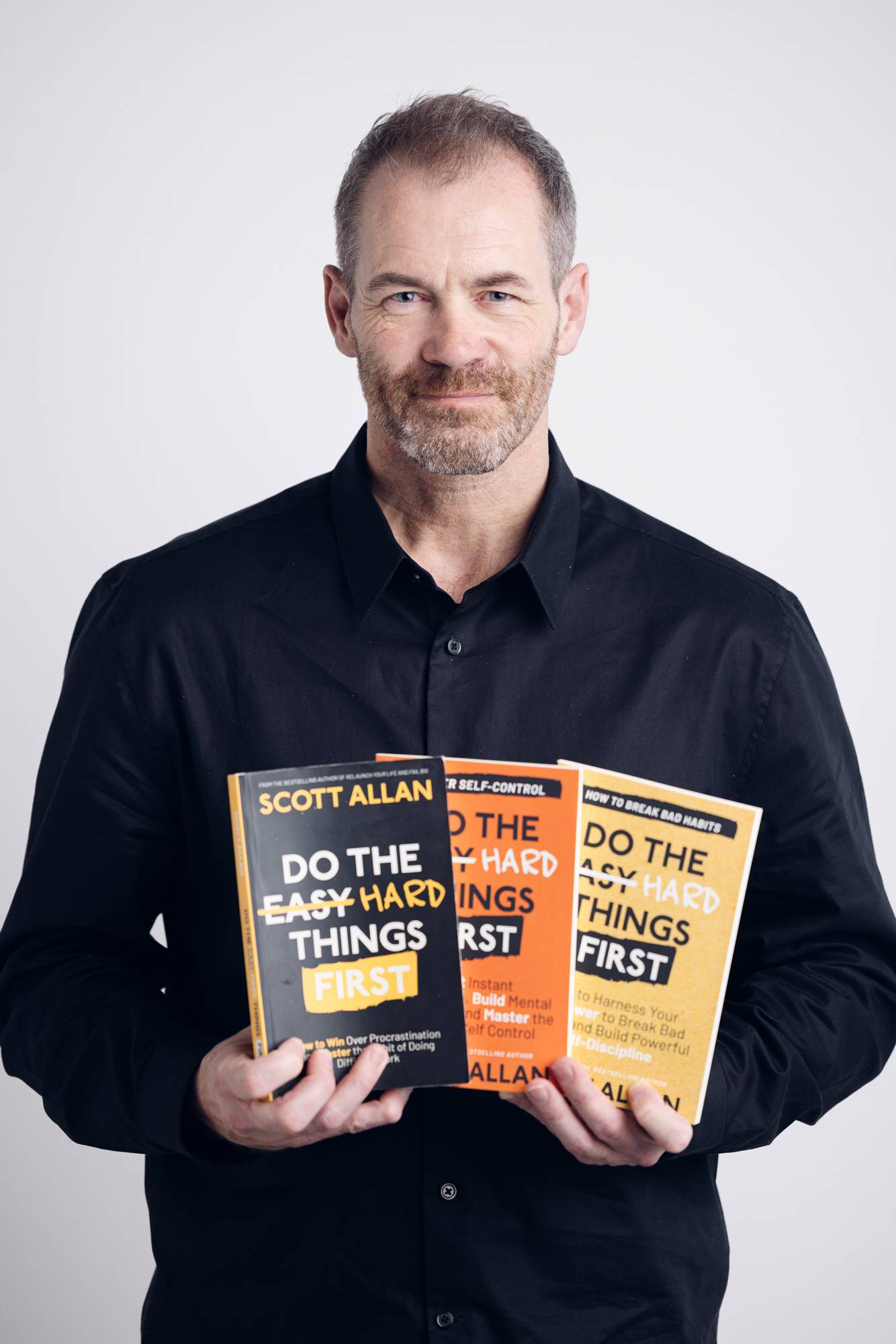
Do the Hard Things First is the complete system for doing exactly that.
JOIN THE CHALLENGE—YOUR NEW RESET BEGINS TODAY
→ Start the Challenge — Use promo code PROC10 for 10% off
→ Order Do the Hard Things First on Amazon
→ Or order directly from scottallanbooks.com
Want the full library of Do the Hard Things First? — Eight books covering every hard thing across disciplines, relationships, money, identity, and more.
Start learning today and build an indestructible lifestyle with the Do the Hard Things First bundle set
 |
$5.00
Scott Allan
Hi, I'm Scott Allan...
Thank You for Your Support!
Your encouragement and support mean the world to me. If you’ve found... Read more |
