July 11th, 2026
During the years I was setting three alarms and hiding from the day, I was terrified of one thing above everything else.
Not failure. Not hardship. Not the work itself.
I was terrified of ending up ordinary.
Of coming to the end of my life having been adequate. Sufficient. Fine.
Of being the person who had potential and never did anything specific with it. The person whose life, when examined closely, revealed nothing that couldn't have been built by anyone.
That fear felt like ambition. It felt like standards. Like refusing to settle for less than what I was capable of.
What it actually was — and this took me a long time to see — was the fear running the avoidance. I was so afraid of proving I was ordinary that I couldn't bring myself to do the everyday work that would have proved otherwise.
Every morning I stayed in bed was a morning I hadn't failed yet. Because I hadn't really started yet.
The fear of ordinary was keeping me the most ordinary version of myself. Stuck. Doing nothing. Waiting for conditions that would guarantee the extraordinary before I committed to the work.
The fear of being ordinary is one of the most effective traps there is. Because it looks exactly like ambition — right up until you examine what it's actually producing.
How the Fear of Ordinary Masquerades as Ambition
The fear of ordinary and genuine ambition look nearly identical from the outside. Both produce striving. Both produce dissatisfaction with the current level. Both push toward more.
The difference is what happens when the path gets unglamorous.
Genuine ambition can tolerate ordinary days — the unremarkable Tuesday of showing up and doing the work when nothing dramatic is happening and no one is watching. It doesn't require the work to feel significant in the moment. It trusts the accumulation.
The fear of the ordinary cannot tolerate those days. Because ordinary days feel like evidence — like proof that this is all there is, that the extraordinary life isn't coming, that the fear was right all along.
So it manufactures urgency. It restarts rather than continues. It chases the new thing that feels more significant than the current thing, which has started to feel too much like regular work.
I did this for years. New ideas felt like proof I was still on the path to something remarkable. Sticking with one thing long enough that it stopped feeling exciting felt too much like settling. The fear kept me moving — but never forward.
The fear of ordinary produces the appearance of ambition while undermining the consistency that ambition actually requires.
What Ordinary Actually Is
Here is something worth sitting with: most of what produces an extraordinary life is ordinary.
The writer who has built something real writes ordinary words on ordinary mornings.
The athlete who performs at an exceptional level trains on ordinary days when the motivation isn't there, and the performance feels unremarkable.
The relationship that endures is built through ordinary conversations, ordinary kindnesses, ordinary days that compound into something rare.
The extraordinary is not the opposite of ordinary. It is what ordinary becomes when it's done consistently, honestly, and for long enough.
What broke the catatonic cycle for me wasn't a dramatic moment. It was three months of ordinary daily practice — the same system, the same time, the same commitment, repeated until it stopped feeling like effort and started feeling like identity.
Nothing remarkable was happening in any individual day. But enough ordinary days stacked into something that couldn't have been built any other way.
That's when I understood the 1% rule. Not as a productivity strategy — as a philosophy.
Small, ordinary, consistent progress compounds into something that looks extraordinary from the outside but was built entirely from the inside, one unremarkable day at a time.
The ordinary day is not the enemy of the extraordinary life. It is the only path to it.
What the Fear Is Really Protecting
The fear of ordinary, at its root, is protecting something specific.
Usually one of these.
The belief that you're special — not ordinary-special, but uniquely, demonstrably, visibly special.
And the hard thing about that belief is that it has to be proven. Every day that passes without visible proof is a day the belief is at risk.
So the fear generates constant striving — not toward something specific, but away from the feeling of not yet having been proven.
The story about what your life is supposed to look like. The story — absorbed from family, from culture, from comparison — of what a life well lived looks like.
Extraordinary career.
Remarkable contribution.
A legacy that justifies the existence. Any day that doesn't match the story feels like failure.
The avoidance of the grief that comes from letting the story go. The alternative to fearing the ordinary is to accept that a well-lived life might look quieter than you imagined.
That the meaningful thing might not be the remarkable thing. And accepting that requires grieving the story — which is genuinely hard work that most people never do.
The Reframe Worth Making
What if the goal isn't extraordinary?
What if the goal is real — honest, connected, fully inhabited, genuinely your own?
Real life isn't ordinary or extraordinary by the measures that generate fear. It's particular. It's yours.
It's built from the specific things that matter to you rather than the things that prove something to an imagined audience.
The fear of ordinary is almost always calibrated against external measures — what looks impressive, what gets noticed, what would make someone else agree that your life counted for something.
The alternative is internal measures. What feels true. What you'd build if no one was watching and nothing was being proven. What the days look like when the striving stops, and the living starts.
That alternative might look ordinary from the outside. It might not make an impressive story. But it might be the most extraordinary thing you ever build — because it's actually yours.
An ordinary life, fully inhabited, is more extraordinary than a remarkable life spent proving something.
Your H.A.R.D. Action This Week
H — Name what the fear of ordinary is making you avoid.
Not the feeling — the behavior.
Are you restarting instead of continuing?
Chasing new things instead of building the current one?
Avoiding the unglamorous daily work because it feels too ordinary to be the path?
Name it specifically.
A — Do the ordinary work today without needing it to feel significant.
The rep no one sees. The practice that doesn't feel like it's adding up. The Tuesday that looks like every other Tuesday.
Do it anyway — because this is where everything real is built.
R — Show up for the ordinary work every day this week.
One unremarkable rep per day. No fanfare. No significance required. Trust the accumulation the way I had to trust it during those three months — before anything visible had changed.
D — When the reach for something more significant arrives, delay it.
The impulse to chase something that feels more remarkable — delay it until the ordinary work is done.
The significance isn't in the feeling. It's in what enough ordinary days build.
Stop running from ordinary. The people who built something real built it from ordinary days, owned completely, without apology. Start owning yours
Go Deeper
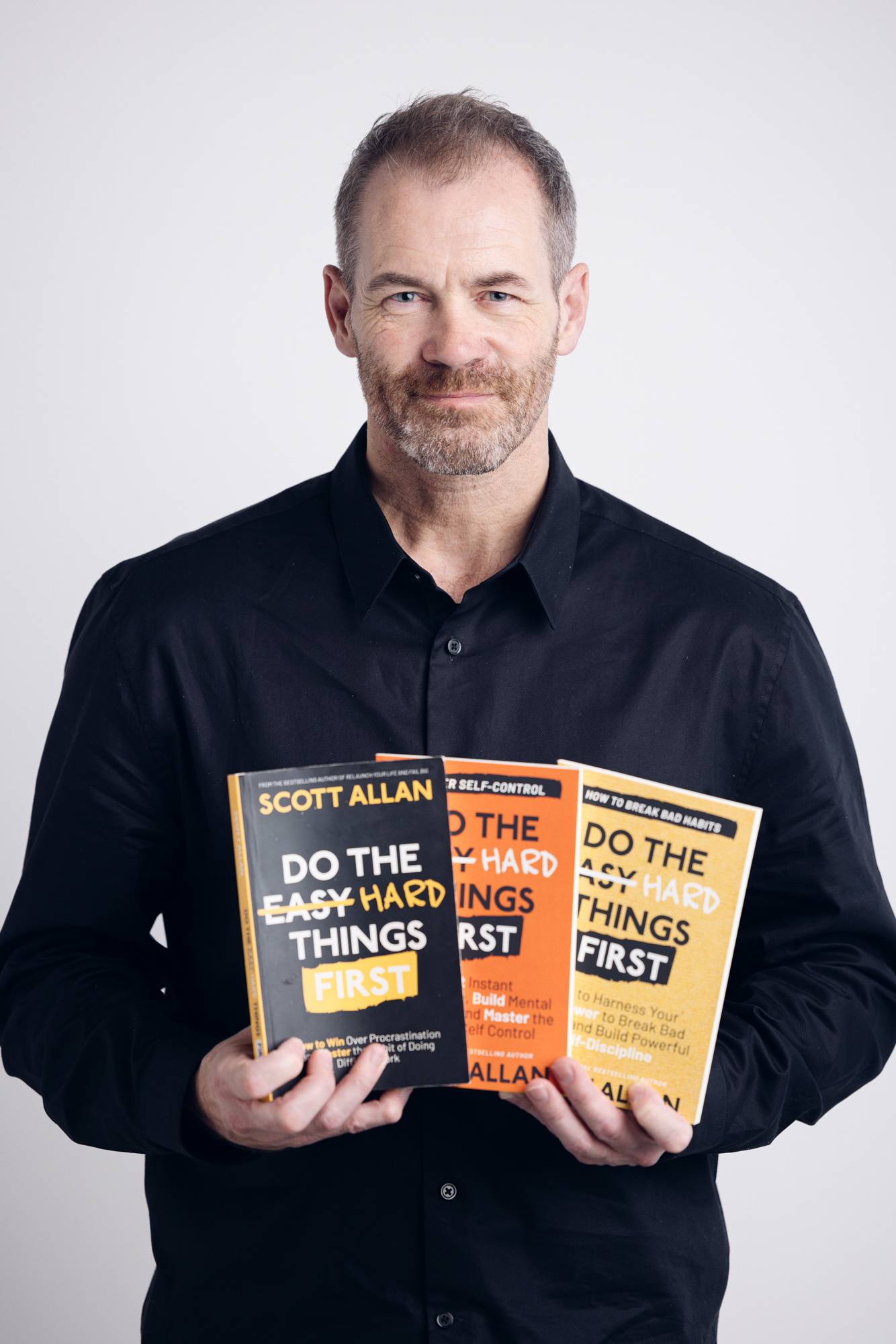
I built this system because I needed it. The catatonic years weren't a discipline problem — they were a systems problem. Do the Hard Things First is the philosophy underneath the operating system. Destroy Your Weak Mind is the identity work that makes the system stick.
→ Subscribe to the Hard Things First Newsletter — new issue every Saturday morning, free to join.
→ Order Do the Hard Things First on Amazon
→ Or order directly from scottallanbooks.com
→ Get Destroy Your Weak Mind — the companion book on building the mental foundation the system runs on.
Want the full library? Scott Allan's Signature 16-Book Best Collection — sixteen books covering every hard thing across discipline, relationships, money, identity, and more.
Not sure where to start? Download the Action Vault — 9 free action guides to beat procrastination, build discipline, and take action immediately.
Ready to go all in? The 30-Day Hard Things Challenge is thirty days of running the system — one hard thing first, every day.
→ Start the Challenge — Use promo code PROC10 for 10% off
 |
$5.00
Scott Allan
Hi, I'm Scott Allan...
Thank You for Your Support!
Your encouragement and support mean the world to me. If you’ve found... Read more |
