What You're Really Saying When You Say "I Don't Have Time"
The Hard Things First Newsletter
"I don't have time."
You've said it this week. Probably more than once. About the workout, the project, the conversation, the thing you've been meaning to get to for months.
It feels true when you say it. The days are full. The demands are real. The hours genuinely disappear.
But here's what I've learned — and it took longer than I'd like to admit: "I don't have time" is almost never true. It's almost always a translation.
What It's Actually Translating
Language is rarely precise when it comes to things we'd rather not face.
"I don't have time" is three words doing the work of a much harder sentence. Here's what it usually means:
"This isn't a priority — but I don't want to say that out loud."
Because saying "this isn't a priority" is honest. And honest means owning the choice. It means acknowledging that you're not choosing the workout, not choosing the project, not choosing the relationship work — that you're actively choosing something else instead.
"I don't have time" lets you off that hook. It suggests the choice was made by the calendar, not by you. That you'd love to do the thing — you just physically couldn't fit it in.
But you watched television last night. You scrolled for twenty minutes this morning before getting out of bed. You spent forty minutes in a meeting that could have been an email. You had time. You spent it on something else.
That's not a judgment. That's just what's true.
View the Visual Slide Deck Here
The Audit That Changes Everything
For one week I tracked exactly where my time went. Not where I thought it went — where it actually went.
The results were uncomfortable.
The hours I thought I didn't have were there. They were just distributed across things I hadn't consciously chosen — small distractions that added up, low-value tasks I could have delegated or dropped, transition time that disappeared into nothing.
The thing I'd been saying I didn't have time for? If I'd protected ninety minutes three times a week, it would have been done months ago.
Try this. Before you say "I don't have time" again, ask yourself four honest questions:
1. What did I spend time on yesterday that I didn't consciously choose? Passive scrolling. Reactive email. Conversations that ran long. Television that filled silence. This is where the time goes — not into nothing, but into the unexamined default.
2. If this thing were truly urgent — if someone was depending on it today — would I find the time? Almost certainly yes. Which means the time exists. The urgency is just low enough that other things keep winning.
3. What am I actually prioritizing when I don't prioritize this? Name it. Not abstractly — specifically. When you skip the workout you're not "too busy." You're choosing something else. Name what you're choosing. Look at it directly.
4. If I gave this thing just thirty minutes a day, what would be different in ninety days? The answer to that question is usually the answer to why you've been avoiding the honest conversation about time.
Use the promo code proc50 to begin your training at 50% off the price
Priority Is Revealed by Behavior, Not Intention
What you intend to do tells you what you value in theory.
What you actually do tells you what you value in practice.
These two things are frequently, uncomfortably different.
Most people have a gap between their stated priorities — health, relationships, meaningful work, creative projects — and their actual priorities as revealed by where their hours go. They say the important thing is important. Then they spend their time on other things.
The gap isn't filled with bad intentions. It's filled with the endless stream of easier, more comfortable, less resistant things that absorb time without asking permission.
You don't find time for what matters. You make it. And making it requires taking it from something else.
That's the uncomfortable truth underneath "I don't have time." Something has to lose for the important thing to win. And choosing what loses is harder than pretending the time just isn't there.
The H.A.R.D. Way to Reclaim Your Time
Time isn't the problem. Honesty is. And the H.A.R.D. Framework starts with honesty — every single day.
H — Highlight the Hard Thing You "Don't Have Time" For
Name the specific thing you've been claiming time scarcity around.
Not "I don't have time to work on my health." Try: "I haven't worked out in three weeks because I've been choosing sleep over early mornings and television over evenings."
That specific, that honest. The moment you name it accurately, the "no time" defense collapses and the real decision appears: is this worth protecting time for or not?
A — Approach It Immediately — with a time block, not a wish
Wishes don't make it onto calendars. Decisions do.
Block the time today. Not "I'll try to get to it this week" — a specific slot, in your calendar, treated like an appointment you can't cancel. Thirty minutes. Ninety minutes. Whatever the minimum viable block is.
Approach the scheduling the same way you approach the work — immediately, before resistance convinces you the time doesn't exist.
R — Rewire the Default with Protected Time
The reason unimportant things absorb your time is that they're the default. They fill the unprotected space automatically.
Protect the space first. Schedule the hard thing before the default fills in around it. The meeting gets scheduled. The deadline gets met. The appointment gets kept. Your most important work deserves the same treatment.
One protected block per day. That's the rep. Over time the protected block becomes the habit and the default reorganizes around it — not the other way around.
D — Delay Everything Else Until the Protected Time Is Kept
Email can wait until after the hard thing. Meetings can start after the protected block. The inbox will survive ninety minutes without you.
Delay the reactive, responsive, low-value time fillers until after you've honored the commitment to the hard thing. This isn't about being unavailable. It's about being available to the right things first.
Hard thing first. Everything else after. The day reorganizes itself around that one decision.
The Honest Version
Here is the sentence I try to say now instead of "I don't have time":
"I haven't made this a priority yet."
It's harder to say. It puts the choice back where it belongs — with me. It removes the comforting fiction that the calendar made this decision. It requires me to look directly at what I'm choosing and what I'm not.
And sometimes the honest answer is: this genuinely isn't a priority right now. Other things matter more. And that's a legitimate choice — as long as it's a conscious one.
What isn't legitimate is pretending the choice doesn't exist. Pretending the time isn't there. Saying "I don't have time" about the things that matter most while spending hours on the things that don't.
You have time. The question is what you're spending it on — and whether you're willing to be honest about the answer.
Your H.A.R.D. Action This Week
H — What have you been saying, "I don't have time" for? Write the honest translation: "I haven't made this a priority because _______________."
A — Block thirty minutes for it in your calendar today. Not this week. Today. Specific time. Non-negotiable.
R — Protect that block every day this week. One rep per day. The habit builds from the protected block, not the intention.
D — What will you delay until after the block is kept? Email. Social media. The first coffee. Name it. Hold to it.
You don't have a time problem. You have a priority problem. And priority problems are solved by decisions, not calendars.
View the Visual Slide Deck Here
Go Deeper [and How I Can Help You]
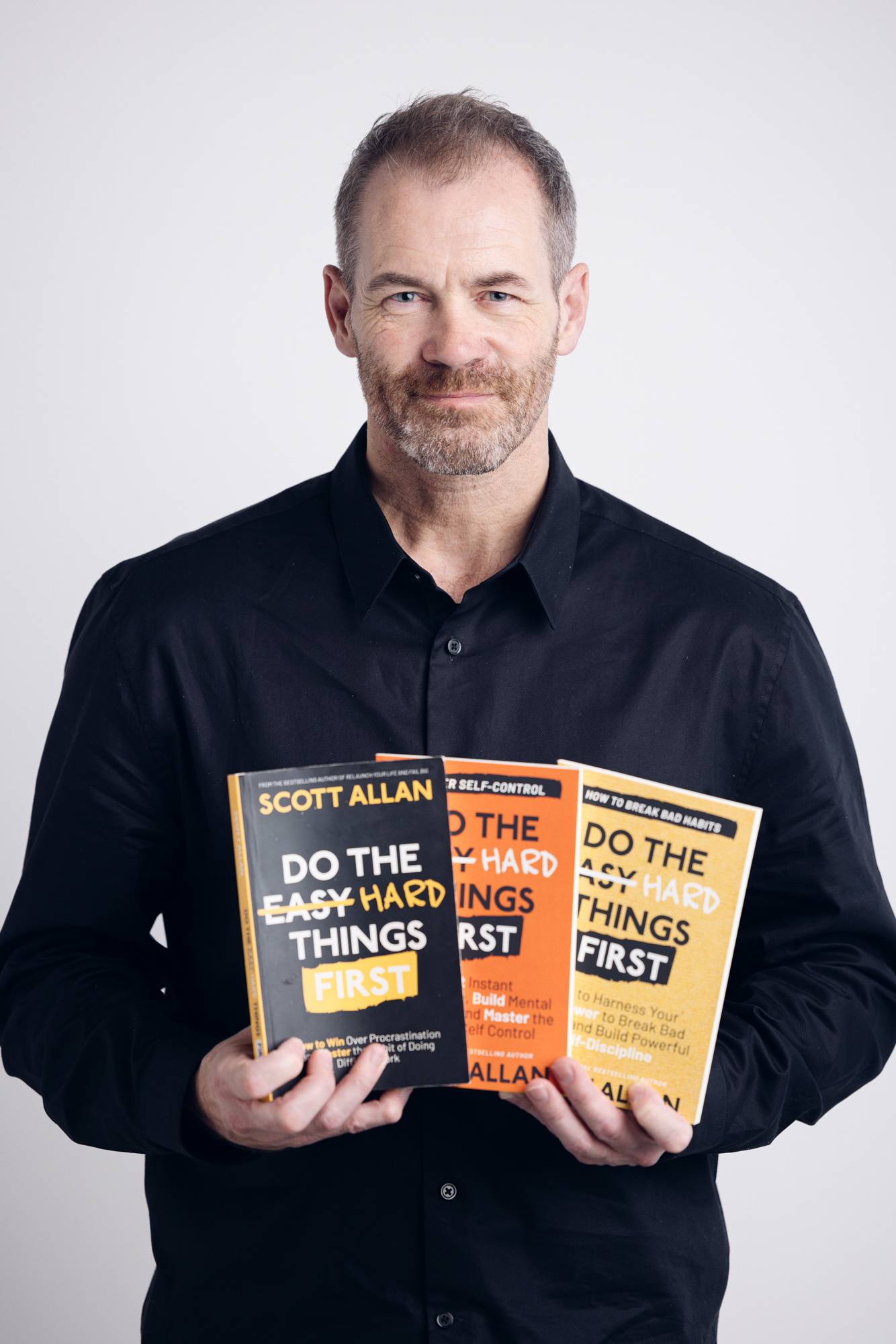
If fear is the thing standing between you and the life you want, Do the Hard Things First is the system for moving through it — understanding why we avoid, what it costs us, and how to act anyway.
→ Find everything in one place: linktr.ee/ScottAllan
If you've been telling yourself stories that keep you stuck, Do the Hard Things First is the system for seeing through them — understanding the psychology of avoidance and building the habit of honest action.
→ Order Do the Hard Things First on Amazon
→ Or order directly from scottallanbooks.com
Not sure where to start? Download the free 24-Hour Discipline Reset — a simple one-day reset to break the avoidance cycle and build momentum fast.
Ready to go all in? The 30-Day Hard Things Challenge is thirty days of facing what you've been avoiding, one hard thing at a time.
→ Start the Challenge — Use promo code PROC50 for 50% off
 |
$5.00
Scott Allan
Hi, I'm Scott Allan...
Thank You for Your Support!
Your encouragement and support mean the world to me. If you’ve found... Read more |


