July 25th, 2026
There are two versions of you.
One shows up before the world makes any demands. Before the inbox fills. Before the notifications stack up. Before anyone needs anything.
This version does the hard thing first — quietly, without audience, before the day has had a chance to take that window away from them.
The other version negotiates. Hits snooze. Checks the phone before getting up. Starts reactive and spends the rest of the day trying to catch up to itself.
I was the second version for a long time. Three alarms. Three negotiations. I still lost every morning before 7 AM. And the cost wasn't just the hour.
It was what the lost hour said about who I was becoming. Every morning I chose the snooze was another vote for the version of me that didn't show up.
What I eventually understood is that this was never a schedule problem. It was an identity problem. The version of me setting three alarms didn't believe he was the kind of person who got up and did hard things.
And that belief made itself true every single morning.
You don't build discipline and then become someone. You become someone through the discipline. The 6 AM version of you is built — not discovered.
Why It Gets Built in the Dark
Nobody sees the early session.
Nobody watches the work that happens before the city is awake.
Nobody gives you credit for the 6 AM decision to do the hard thing before checking what everyone else needs.
That's exactly why it matters.
The version of you that shows up when no one is watching — when there's no external pressure, no deadline forcing action, no audience to perform for — is the truest signal of who you're becoming.
Not who you perform as. Who you actually are.
Every morning you show up builds a piece of evidence. Not for anyone else. For yourself. Evidence that you're the kind of person who does this. Evidence that the negotiation is over. Evidence that the identity has shifted.
Three months of that evidence is what changed everything for me. Not one dramatic morning. Three months of ordinary ones that nobody saw and nobody can undo.
The Story Keeping You From That Version
Most people who don't show up in the morning have a story about why.
"I'm not a morning person."
This is the most common one and also the least examined.
Morning person is not a biological category. It is an identity. And identities are built through behavior, not discovered through temperament.
Every person who currently shows up at 6 AM was once someone who didn't.
"I work better at night."
Sometimes true. More often a story constructed around the avoidance.
The question worth asking: is the night work actually happening? Or is the night being spent on the same numbing behaviors that would have filled the morning?
"I don't have enough time in the morning."
This is an environment problem, not a time problem. The morning doesn't have enough time because it hasn't been designed for it.
The people who have time in the morning built that time deliberately — by moving things around, by setting up the night before, by deciding the morning matters enough to protect.
Every story has the same function: it makes the absence of the 6 AM version feel inevitable rather than chosen. But it is always chosen. And it can be chosen differently.
How That Version Gets Built
It doesn't happen by waking up earlier. It happens by deciding — specifically and in advance — what that version of you does when they get up.
The night before matters more than the morning itself. Decide tonight what tomorrow's hard thing is.
One thing, not a list.
Set the environment: clear the desk, open the document, put the phone in another room. Remove every decision from the morning that doesn't need to be there.
Then in the morning, move within five seconds of the alarm.
Not after deliberation. Before it.
The deliberation is where the second version lives. The five-second window is where the first version gets built or doesn't.
Do that enough mornings and something shifts.
Not overnight. Over weeks.
The alarm stops being a negotiation. The hard thing stops feeling optional. The identity of someone who shows up — quietly, consistently, before the world is watching — stops being something you're trying to be and becomes something you simply are.
That's what the 1% rule means in practice.
Not 1% better output.
1% closer, every day, to the version of you that shows up without being told to.
Your H.A.R.D. Action This Week
H — Decide right now which version showed up most this week.
Honest answer only. Not the version you want to have been. The one that actually appeared. That gap between the two is the exact work in front of you.
A — Set up tomorrow night before you go to sleep.
One hard thing named. Environment ready. Phone in another room. Every obstacle between waking and starting removed tonight so the morning-you has no decisions left to make.
R — Show up before the world demands anything, every morning this week.
Seven mornings. Same commitment. The evidence builds whether you feel it building or not. Consistency is the whole point.
D — Delay everything reactive until after the hard thing is done.
No phone. No email. No news. The world gets you after. The version who shows up gets the first hour. Every day this week.
The version of you that shows up at 6 AM is not who you are yet. It is who you are becoming. Every morning is a vote. Cast the right one starting tomorrow.
Go Deeper
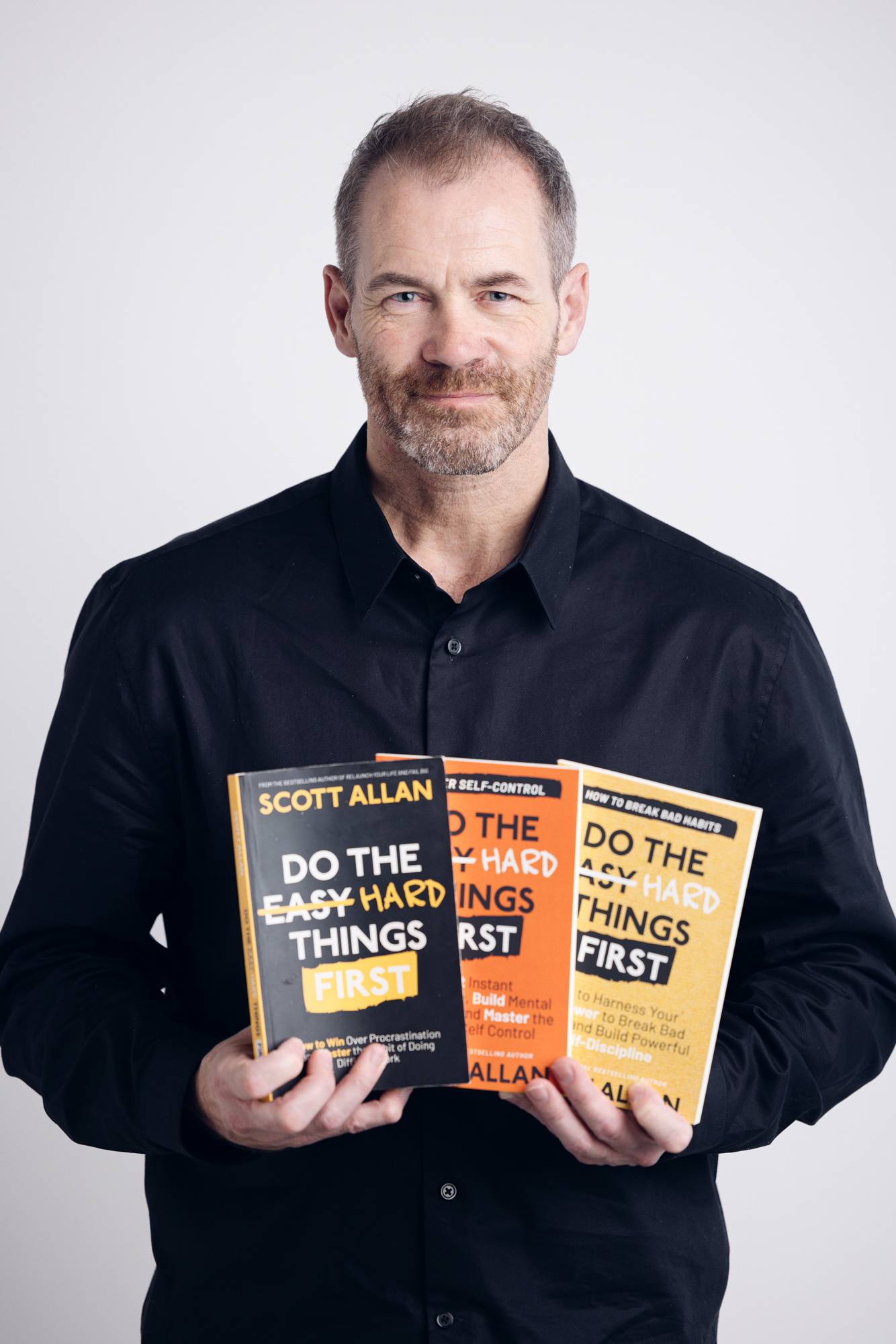
The second version of me set three alarms and lost every morning. Building the first version took three months of ordinary mornings that nobody saw. Do the Hard Things First is the system that made that possible.
→ Subscribe to the Hard Things First Newsletter — new issue every Saturday morning, free to join.
→ Order Do the Hard Things First on Amazon
→ Or order directly from scottallanbooks.com
→ Get Destroy Your Weak Mind — the companion book on building the mental foundation the system runs on.
Want the full library? Scott Allan's Signature 16-Book Best Collection — sixteen books covering every hard thing across discipline, relationships, money, identity, and more.
Not sure where to start? Download the Action Vault — 9 free action guides to beat procrastination, build discipline, and take action immediately.
Ready to go all in? The 30-Day Hard Things Challenge is thirty days of running the system — one hard thing first, every day.
→ Start the Challenge — Use promo code PROC10 for 10% off
 |
$5.00
Scott Allan
Hi, I'm Scott Allan...
Thank You for Your Support!
Your encouragement and support mean the world to me. If you’ve found... Read more |
