August 15th, 2026
You are already in pain. The only question is which pain you are choosing.
Not whether to be in pain.
Which pain.
That distinction is the difference between a life that compounds in your favor and a life that compounds against you.
I spent years in the wrong pain without knowing I was choosing it. The mornings of avoidance felt like relief — staying in bed, pushing off the work, choosing the comfortable version of the day over the one that would have required something real from me.
It didn't feel like pain. It felt like rest.
What was accumulating underneath was something else entirely. The growing distance between who I said I would be and who I actually was. The quiet erosion of confidence that comes from breaking promise after promise to yourself.
The weight of carrying work you know you should be doing and aren't.
That is the pain of regret. And it accumulates in silence, below the surface, while you choose comfort.
The day I understood that I was not avoiding pain but simply trading one pain for another — and making a terrible trade — everything shifted.
Discipline weighs ounces. Regret weighs tons. You will carry one of them.
You must choose deliberately.
Access the Visual Slide Deck here
The Pain of Regret
Regret is not the emotion you feel when you look back on your life at seventy. That is only where it announces itself loudly.
Regret is already working on you.
Today.
In the low-level dissatisfaction that sits underneath a day spent choosing comfort over the important thing.
In the quiet voice that shows up on Sunday nights.
In the restlessness that exists without a clear source.
In the feeling that time is moving faster than your life is progressing.
You know exactly what this feels like because you are already living with some version of it.
Here is what makes the pain of regret uniquely destructive:
It compounds.
Every day you choose the comfortable option over the disciplined one, you pay today's cost — the thing undone, the promise unkept — and you add to tomorrow's balance.
The undone thing becomes harder to start. The promise becomes harder to believe. The gap between where you are and where you intended to be becomes wider and, eventually, too wide to look at directly.
This is how the catatonic years worked for me. It was not one bad decision. It was the accumulation of thousands of small comfortable choices, each one reasonable in isolation, collectively producing a life that felt nothing like the one I had intended.
The regret did not arrive all at once. It was already there, building quietly, invisible until it wasn't.
The pain of regret is also unchosen.
You do not decide to carry it. It arrives as the natural consequence of consistently choosing the easier option.
And because it arrives slowly and silently, you are often deep in it before you recognize what it is.
The Pain of Discipline
The pain of discipline is not what you have been imagining.
Your brain has been avoiding it based on a prediction — the prediction that it will be worse than the alternative.
That the discomfort of doing the hard thing will be unbearable, humiliating, or beyond what you can sustain.
That prediction is almost always wrong.
The pain of discipline is real.
The early morning is genuinely uncomfortable.
The difficult conversation is genuinely hard.
The project that requires focused effort without motivation is genuinely demanding.
These things are not painless.
But they are bounded.
The discomfort of a hard workout ends when the workout ends.
The discomfort of a difficult conversation ends when the conversation ends.
The discomfort of sitting with a difficult project ends when you close the laptop.
The pain has a natural edge. You can see through it to the other side.
Regret has no edge. It does not end when you stop thinking about it. It compounds while you sleep. It builds interest overnight.
The comfortable choice you made today to avoid the disciplined pain becomes tomorrow's heavier regret — and next month's heavier one still.
This is the trade you are making every time you choose comfort.
A bounded, survivable, productive discomfort now — for an unbounded, compounding, corrosive regret later.
It is the worst trade available, and it is the one most people make by default, every day, because the regret arrives slowly enough to seem manageable right up until it isn't.
How to Choose Deliberately
Most people do not choose their pain.
They default to it.
The default is always comfort in the immediate moment — because comfort is available first, costs nothing upfront, and the regret bill doesn't arrive until later.
The system is rigged toward the wrong choice unless you intervene deliberately.
Here is how to intervene.
Name the choice in front of you right now.
Not in abstract terms — specifically name it.
- The workout you are considering not doing.
- The project you are considering deferring.
- The conversation you are considering avoiding.
Name the comfortable option and name the disciplined option. Put them both on the table.
Then ask: which pain am I choosing? Not which option feels better right now. Which pain am I signing up for — the bounded discomfort of doing it, or the compounding regret of not doing it?
Asked that way, the choice changes. The discomfort of the disciplined option does not disappear, but its cost becomes visible and containable.
The comfort of the easier option does not disappear either, but its real price — paid in regret over time — becomes visible too.
You cannot make a deliberate choice between two pains you have not named.
Name them.
Then choose the one that builds you.
Take Action Today
Find the choice in front of you right now where you have been defaulting to comfort.
Not the dramatic one — the ordinary one.
The small daily decision where the comfortable option keeps winning without a contest because you have not been framing it as a choice at all.
Name both pains on paper. The bounded discomfort of the disciplined option. The compounding regret of the comfortable one. Write them both down.
Then choose the disciplined option today. Once. Not as a permanent transformation — as a single deliberate choice that interrupts the default.
Do it again tomorrow. And the day after.
Not because it gets easier immediately, but because each deliberate choice builds the evidence that you are someone who chooses the right pain.
That evidence is what changes the default over time.
You are already in pain. Make it the kind that builds something.
How Scott Allan Can Help You
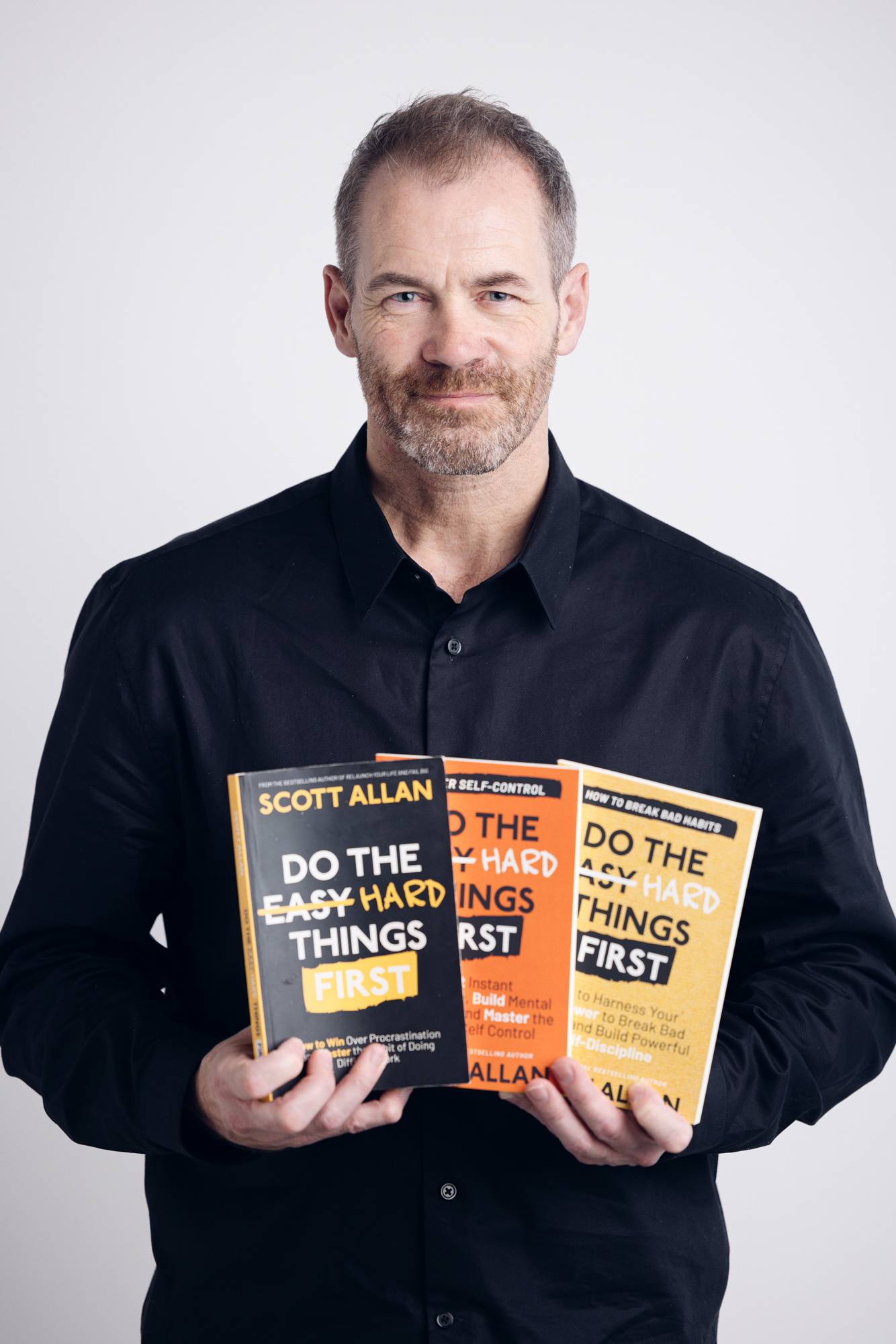
→ Order Do the Hard Things First on Amazon
→ Or order directly from scottallanbooks.com
Want the full library? Scott Allan's Signature 16-Book Best Collection — sixteen books covering every hard thing across discipline, relationships, money, identity, and more.
Ready to go all in? The 30-Day Hard Things Challenge is thirty days of running the system — one hard thing first, every day.
→ Start the Challenge — Use promo code PROC10 for 10% off
 |
$5.00
Scott Allan
Hi, I'm Scott Allan...
Thank You for Your Support!
Your encouragement and support mean the world to me. If you’ve found... Read more |
