September 20th, 2026
You are not stuck at 80 percent. You are avoiding what happens at 100.
This is the part of finishing nobody talks about.
Everyone will tell you that discipline is required to start.
Fewer people will tell you the truth about what stops most projects cold in the final stretch: not a lack of time, not a lack of skill, not even a lack of discipline in the way you have been taught to think about it.
What stops you at the end is fear.
Specific, nameable fear.
And it is not the fear of the work. It is the fear of what the work means once it exists in the world.
I know this one intimately. For years, what held me back from finishing anything wasn't the difficulty of finishing itself.
It was what finishing required me to face next.
If I finish it, I have to launch it. If I launch it, people see it. If people see it, they can reject it.
Nobody buys the thing. Nobody reads the book I spent six months writing. Nobody likes it.
The fear was never really about the work. It was about what the completed work would expose me to.
As long as the project stays at 80 percent, none of that can happen yet. The unfinished thing cannot fail, because it has not been given the chance.
It exists in a permanent state of almost. Safe. Protected. Still full of potential precisely because it has never been tested against reality.
Finishing ends that protection. Finishing is the moment the potential becomes an actual, judgeable thing.
That is what you are actually avoiding when you stall in the final 20 percent.
Not the work.
The verdict.
A half-built bridge does not get you anywhere. It doesn't matter how solid the first eighty percent was. You need one finished bridge, not a collection of impressive gaps.
Why the Last 20 Percent Is Different From the First 80
The first 80 percent of any project runs on momentum, discovery, and the pleasure of building something new.
Early progress is visible and rewarding. Each session produces something that did not exist before.
The work still feels open-ended, full of possibility, not yet locked into a final, judgeable form.
The last 20 percent is different in almost every way. The interesting problems have mostly been solved.
What remains is the unglamorous, exacting work of closing every loop, the polish, the corrections, the parts that do not showcase skill so much as demand patience. And underneath all of that unglamorous work sits the growing awareness that finishing this means releasing it.
That the closer you get to done, the closer you get to being seen.
This is why so many genuinely talented, capable people have drawers full of almost-finished things.
It is not a skill gap.
The first 80 percent proves the skill exists.
The stall in the final 20 percent is not a competence problem. It is a courage problem, dressed up as a productivity problem so it is easier to talk about.
You can spend years perfecting a project that never leaves the drawer and never have to find out if it was good enough.
That safety is seductive. It is also a trap, because the safety only lasts as long as you accept never finding out what you were actually capable of.
The Fear Underneath the Stall
Let's name it directly, because naming it is the only way to loosen its grip.
You are afraid that if you finish it and put it out, nobody will want it.
You are afraid the book you spent six months writing will sit unread.
You are afraid the thing you built with real effort and real belief will be met with silence, or worse, rejection.
You are afraid of discovering, in the most public and undeniable way possible, that the answer to "was it good enough" is no.
As long as the project is unfinished, you never have to answer that question. The unfinished project protects you from the verdict by never letting it be rendered.
You can tell yourself, indefinitely, that it would have been great if you had ever gotten around to finishing it. That story is comfortable. It is also a story you can only tell yourself while nothing real gets built.
Here is what I had to face about this pattern in my own work: the fear does not go away by getting better at the craft. You do not out-skill your way past the fear of judgment. Improving the work does not touch the fear at all, because the fear was never really about quality.
It was about exposure. About the specific vulnerability of putting something you made, something that came from you, in front of people who get to have an opinion about it.
The only way through that fear is the same way through every other hard thing in this newsletter: not around it, not by waiting for it to disappear, but directly through it, while it is still there.
What Finishing Actually Requires
Finishing is not a bigger version of starting. It requires a different kind of discipline entirely.
Define done before you begin, not after you're tired of the project. Vague endpoints get renegotiated the moment finishing feels uncomfortable.
A specific, pre-decided definition of done removes that renegotiation. Not "make it as good as possible". A fixed target you can actually reach and recognize when you have reached it.
Separate the finishing from the launching. These are two different fears wearing one costume. Finishing the work and putting it in front of people are not the same act, even though your mind treats them as one continuous, terrifying event.
Finish it first.
Let it exist as a completed thing before you have to decide what to do with it. This alone removes a significant portion of the pressure sitting on the final 20 percent.
Set a bounded deadline for the final push. Open-ended finishing invites endless refinement, and endless refinement is where projects go to avoid ever being done.
A dedicated window—this week, these three days —with a hard stop forces completion instead of letting it drift.
Let it be good enough, not perfect. Perfect is not a real standard. It is a permanent excuse disguised as a standard, because perfect can always be pushed one more draft away.
Good enough to release, judged against your own defined done, is the actual finish line. Everything past that is the fear asking for one more delay.
Release it before you feel ready. You will not feel ready. Readiness is not a precondition for finishing, and it never arrives on schedule.
The book gets published while you are still afraid it isn't good enough.
The product launches while you are still unsure anyone will buy it.
Feeling ready is not required. Finishing anyway is.
One Finished Bridge
Here is the image worth carrying into every unfinished project.
A hundred half-built bridges do not connect anything. It doesn't matter how elegant the first eighty percent of each one is, how much skill went into the foundation, or how promising the design looked from the bank you started on.
None of them get you across.
None of them get anyone across.
They are visible evidence of effort and invisible evidence of nothing actually delivered.
One finished bridge, even an imperfect one, gets you to the other side.
This is the discipline of finishing. Not the discipline of starting well, which most people already understand.
The discipline of walking directly into the specific fear that lives in the final stretch, the fear of being seen, the fear of being judged, the fear that the answer might be no, and finishing anyway.
Not because the fear disappears. Because you have decided that a completed bridge, even one that might not hold everyone's weight, is worth infinitely more than an impressive collection of gaps.
Stop building bridges you never intend to finish crossing. Pick the one closest to done.
Finish it.
Cross it.
This Week's Non-Negotiable
Find the project sitting at 80 percent that you have been circling instead of finishing.
Name the specific fear underneath the stall. Not "I don't have time." The real one. What are you afraid happens once this is done and out in the world?
Write it down exactly as it occurs to you.
Then define done in one specific sentence.
Not perfect, done. The finish line you can actually reach and recognize.
Set a bounded window this week to close the gap. Not open-ended. A hard deadline with a hard stop.
Finish it.
Then let it exist as a completed thing for at least one full day before you decide anything about launching it.
Separate the two fears. Handle them one at a time.
A hundred half-built bridges lead nowhere. Finish the one you are standing on.
Then cross it.
How I Can Help You
For years, I fought a life I had made unnecessarily difficult. Removing the friction — the bad thinking, the weak habits, the comfort addiction — was what finally made the path navigable.
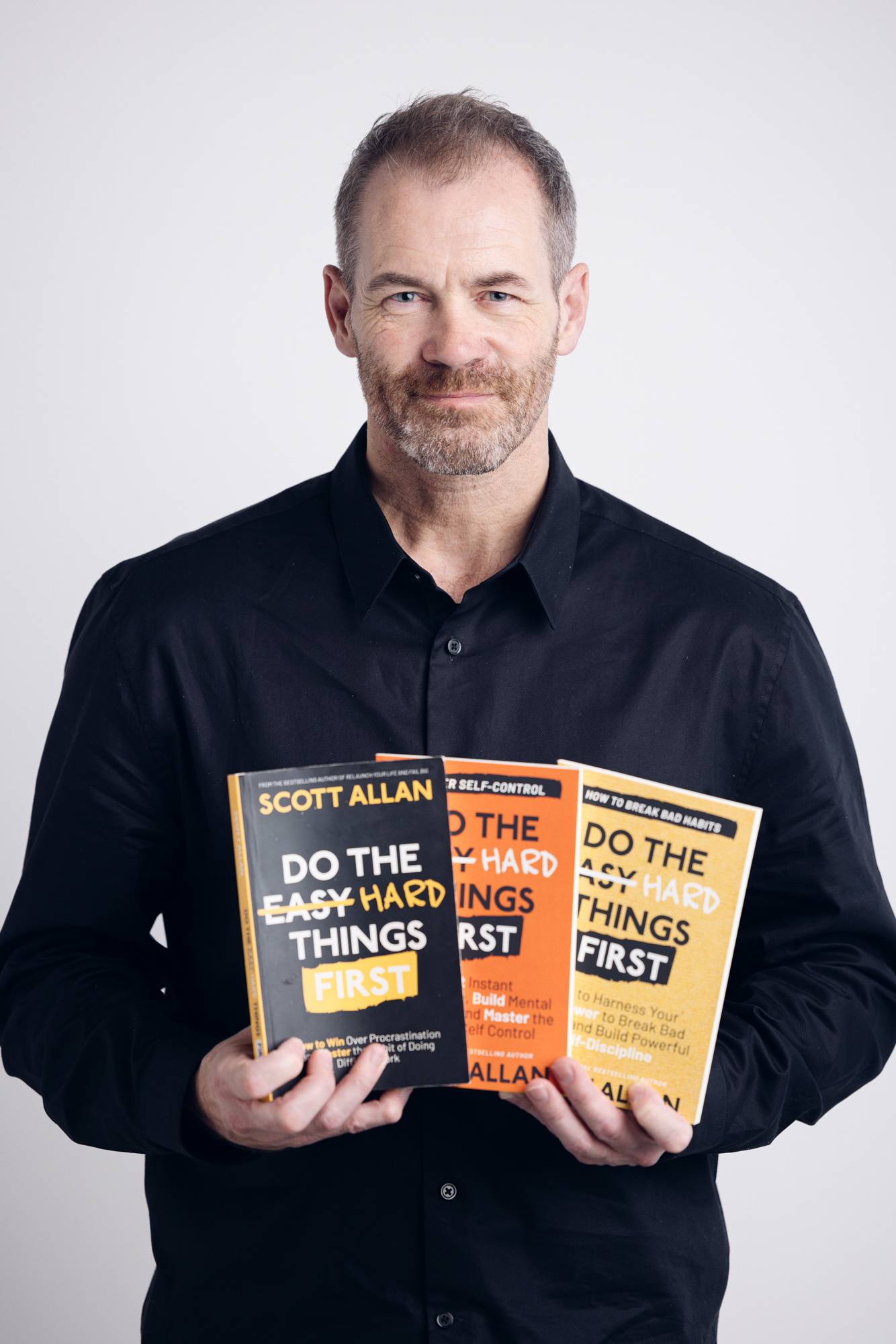
Do the Hard Things First is the complete system for doing exactly that.
JOIN THE CHALLENGE—YOUR NEW RESET BEGINS TODAY
→ Start the Challenge — Use promo code PROC10 for 10% off
→ Order Do the Hard Things First on Amazon
→ Or order directly from scottallanbooks.com
Want the full library? Scott Allan's Signature 16-Book Best Collection — sixteen books covering every hard thing across discipline, relationships, money, identity, and more.
 |
$5.00
Scott Allan
Hi, I'm Scott Allan...
Thank You for Your Support!
Your encouragement and support mean the world to me. If you’ve found... Read more |
