The Boundary You Need to Set (And Why You Keep Avoiding It)
Hard Things First Newsletter—June 13th, 2026
During the worst period of my life — when I was hitting snooze on three alarms and hiding from the day — I was also hitting snooze on every boundary I needed to set.
I let people cross lines I'd drawn in my head but never spoken out loud. I swallowed things that needed to be said. I told myself I was being patient, being understanding, being the kind of person who doesn't make things difficult.
I wasn't being any of those things. I was avoiding.
The pattern was identical to the one that kept me in bed every morning. In bed, I was avoiding the hard work of the day. In my relationships, my work, and every room where something needed to be said — I was avoiding the hard work of the conversation. Same fear. Different address.
And the longer I stayed silent, the more the resentment built. Until the relationship wasn't the warm thing it used to be. It was a minefield I was tiptoeing through every single day.
That's what no boundary costs you. Not one difficult conversation. The permanent, exhausting work of navigating around the thing you never said.
Last week I launched The Scott Allan Signature Collection — 16 of my best books on discipline, resilience, and taking action, all in one place. EBooks, audiobooks, or both. If you missed the announcement, here's the link: THE SCOTT ALLAN SIGNATURE COLLECTION
What a Boundary Actually Is
Before we talk about how to set one, I want to clear something up — because I had this wrong for a long time.
A boundary is not a wall. It is not a punishment. It is not an ultimatum designed to control what another person does.
A boundary is a statement about what you will and won't accept. It describes your limit and the consequence of crossing it. That's it. Simple. Not aggressive. Not cold.
"When you speak to me that way, I need you to stop. If it continues, I'm going to remove myself from the conversation."
That's a boundary. One sentence describing the limit and one sentence describing what happens if it isn't respected. No attack. No lengthy explanation of all the times it's happened before. No apology for having the limit in the first place.
The reason most people avoid setting boundaries isn't that they don't know what they need. It's because they've confused setting a limit with starting a war. Those are not the same thing.
A boundary is just a sentence. The difficulty is not the words — it's the decision to say them.
Why We Let It Keep Happening
There's always a reason that sounds like generosity.
They're going through a hard time. So we let it slide. It's not worth the conflict. So we say nothing. They probably don't realize they're doing it. So we give them another pass. And another. And another.
I used every one of these. Some of them were even partially true. But the honest version of all of them is simpler: I was afraid of what setting the boundary would cost me. Afraid of the reaction. Afraid of losing the relationship. Afraid of being seen as difficult, demanding, or unkind.
What I was unwilling to admit — for a long time — is that not setting the boundary was already costing me the relationship. It was just costing me quietly, in ways I could pretend weren't happening.
Resentment doesn't announce itself. It accumulates. Slowly at first, in small deposits. An eye roll you hide. A short answer when you'd normally have a longer one. A growing reluctance to spend time with the person. A distance that neither of you can name but both of you can feel.
By the time most people finally set a boundary, the relationship is already significantly damaged — not by the boundary itself, but by the years of accumulation that led up to it.
The boundary conversation you're avoiding isn't the threat to the relationship. The continued avoidance is.
The Three Boundaries Most People Keep Not Setting
The one with the person who drains you. The friend who only calls when they need something. The family member whose criticism arrives disguised as concern. The colleague who treats your time as available by default. You've known for a long time this dynamic isn't right. You've had the conversation in your head a hundred times. You haven't had it out loud.
The one at work. The manager who messages you at all hours and expects an answer. The scope that keeps expanding without the compensation following. The meeting that could have been an email, every week, eating into the hours when you do your best work. You tell yourself this is just how things are. It isn't. It's a standard you haven't set.
The one with yourself. This is the one nobody talks about. The boundary you need to set with your own behavior — the late nights that wreck the next morning, the screen time that devours the focused work, the commitments you keep making and immediately resenting. The person most often crossing your limits isn't someone else. It's you. And you can't have the external boundary conversations until you've had the internal one.
What Setting It Actually Sounds Like
Most people over-prepare the wrong thing.
They script the entire conversation — every possible response, every escalation, every way it might go wrong. This is not preparation. It is avoidance dressed as thoroughness.
What you actually need to prepare is two things: the opening and the limit.
The opening:"There's something I need to say, and I've been putting it off because it feels uncomfortable. I'm going to say it now."
That line does more work than people realize. It signals that what follows is intentional, not reactive. It disarms the defensiveness that comes when someone feels attacked without warning. And it gets you past the hardest part — starting.
The limit:"When [specific behavior], I feel [impact]. What I need going forward is [specific change]. If that doesn't happen, I'm going to [specific consequence]."
No lengthy history. No list of every previous offense. No softening so thorough that the limit disappears into the apology. One clear statement. Said once. Then stop talking.
The conversation will go in directions you didn't script. That's okay. You only need to know the opening and the limit. Everything else you can handle as it comes.
The H.A.R.D. Way to Finally Set It
H — Highlight the Specific Boundary You've Been Avoiding
Not "I need to get better at saying no." Specific.
Who is crossing the line? What exactly is the behavior? What is the limit you need to state? Write it in two sentences: the behavior and what you need to change.
I couldn't set limits with people until I named them precisely. Vagueness is where avoidance lives. The moment you write "I need to tell [name] that [specific thing] needs to stop" — suddenly it's real. Suddenly it's avoidance, not patience.
A — Have the Conversation Within 48 Hours
Not when things settle down. Not after the next incident so you have fresh evidence. Within 48 hours of reading this.
Write down your opening line and your limit statement. Tell one person you're going to have the conversation today so there's accountability. Then go have it.
The window of courage closes fast. The story about why now isn't the right time is already forming. Go before it convinces you.
R — Rewire Through Holding the Limit After You Set It
Setting the boundary is hard. Holding it is where most people fail.
The first test almost always comes quickly. The person pushes back, gets upset, tests whether you meant it. This is not a sign that the boundary was wrong. This is the boundary doing exactly what it's supposed to do — making real the limit you stated.
Hold it. Calmly, without escalating, without apologizing for having it. "I understand you're frustrated. The limit I described still stands." That's all that's required. The first time you hold it after setting it, something changes — in the relationship and in you.
D — Delay the Peace That Comes From Saying Nothing
The silence feels like peace. I know. I chose it for years. It's quieter than the conversation. Less immediate risk. Less exposure.
But it's not peace. It's debt. Every avoided boundary adds to the balance — in resentment, in distance, in the low-grade tension of a relationship navigating the unnamed thing.
Delay that false peace. Choose the real conversation over the comfortable silence. The temporary discomfort of setting the limit is nothing compared to the permanent cost of never having set it.
What I Know Now
What I can tell you is this: every relationship that survived a boundary I finally set became more honest. Not easier — more real. Because we both knew where the lines were. We weren't guessing anymore. We weren't tiptoeing.
And the relationships that didn't survive? They were already over. The boundary just made it visible.
The boundary you need to set is not the threat to what matters. Staying silent is. Say the thing. Set the limit. Let the relationship be what it actually is once you do.
Your H.A.R.D. Action This Week
H — Write the boundary in two sentences. The behavior. The limit. Specific. On paper. Right now.
A — Have the conversation within 48 hours. Your opening line: "There's something I need to say, and I've been putting it off." Your limit: written above. Go.
R — Hold the limit the first time it's tested. It will be tested. That's not failure — that's the boundary working. Hold it calmly and without apology.
D — Stop choosing the silence that feels like peace. It isn't peace. It's accumulation. The conversation is cheaper than what the silence is costing you.
The boundary you keep not setting isn't protecting the relationship. It's slowly ending it. Say it this week.
Go Deeper
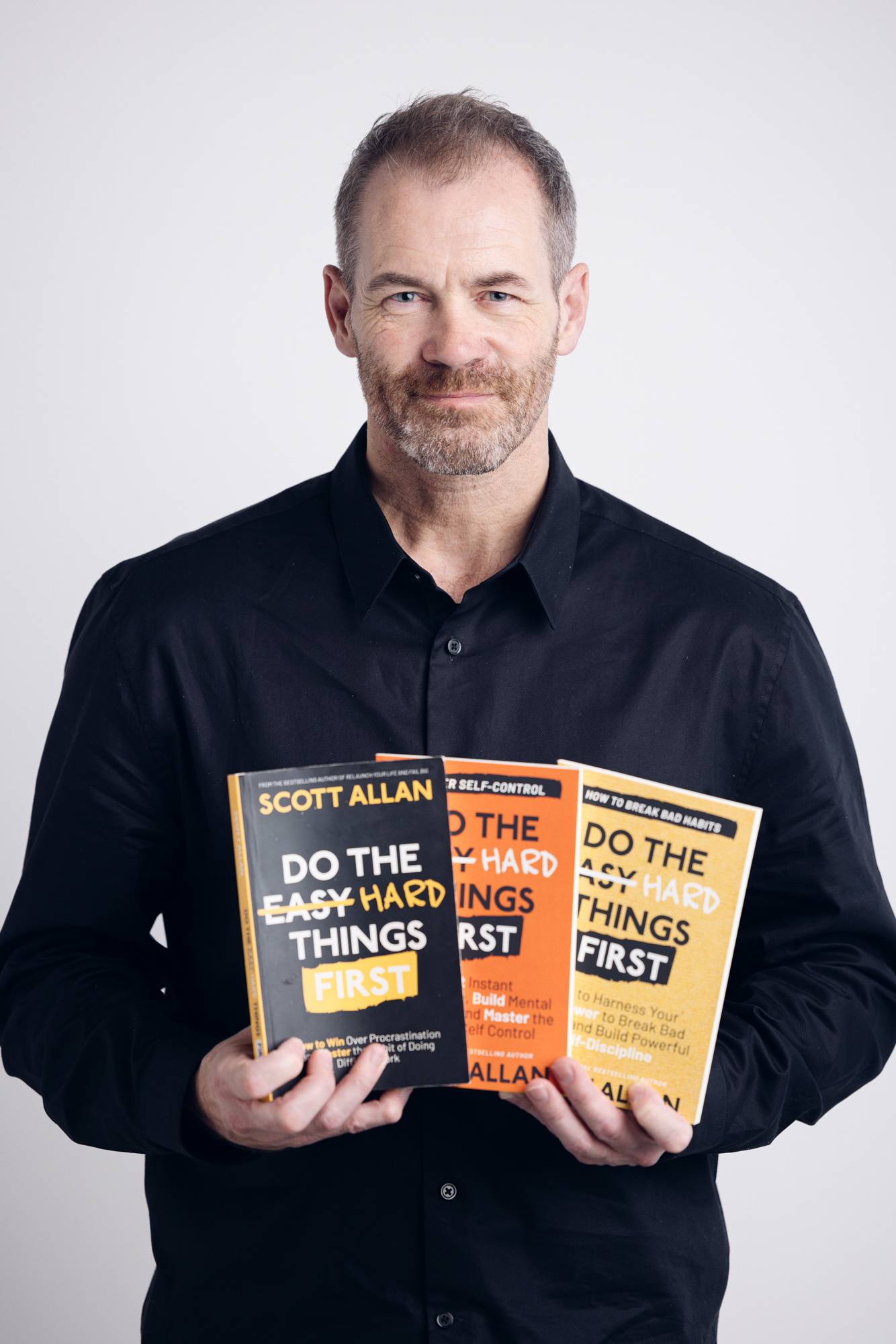
I built the Hard Things First system because I needed it — and after three months of practicing it, it changed everything. If you're ready to stop hiding from the day, Do the Hard Things First is the system that makes that possible.
→ Order Do the Hard Things First on Amazon
→ Or order directly from scottallanbooks.com
Want the full system? Scott Allan's Signature 16-Book Best Collection — sixteen books covering every hard thing across discipline, relationships, money, identity, and more.
Exclusive: Download the 9-Lead Magnet Action Vault here—beat procrastination, build discipline, and take action immediately. No fluff. No drip feed. Instant access.
Ready to go all in? The 30-Day Hard Things Challenge is 30 days of facing what you've been avoiding — including what's hiding behind your best habits.
→ Start the Challenge — Use promo code PROC10 for 10% off
 |
$5.00
Scott Allan
Hi, I'm Scott Allan...
Thank You for Your Support!
Your encouragement and support mean the world to me. If you’ve found... Read more |


