September 27th, 2026
You cannot build the next version of yourself while keeping the current one alive.
Something has to die first.
Not metaphorically comfortable, not a gentle evolution where the old you and the new you coexist peacefully while you slowly transition between them.
An actual ending.
The habits that used to define you, gone.
The identity that used to feel safe, gone.
The people who only fit with who you used to be, gone, or at least changed beyond what they signed up for.
This is the part nobody tells you about transformation.
Everyone sells you the becoming. Nobody sells you the dying, because dying doesn't market well, even though it's the actual mechanism underneath every real change that has ever happened to anyone.
I know this because I had to kill a version of myself that had been running my life for years.
Three alarms, hitting all of them, staying in bed while the day happened without me. Procrastinating on critical work that lost potentially millions when I wouldn't do it.
That version of me had habits, had a way of explaining himself, had relationships built entirely around his limitations being accepted as permanent facts. He was comfortable in his own defeat. He had made peace with it.
He had to go completely before anything else could exist in his place.
You are still protecting a version of yourself that needs to end. You know which one.
The one who explains why things haven't worked, the one who has a story ready for every failed attempt, the one who other people have learned to expect very little from because you taught them to expect very little, repeatedly, until it became the arrangement.
You do not get to keep him and become someone else. You get to kill him, or you get to keep him. Those are the only two options on the table.
Why Keeping It Alive Feels Safer
The old version of you is familiar, and familiar feels safe even when it is actively costing you everything you say you want.
You know exactly how he operates. You know his excuses before he makes them. You know what he'll say when the hard thing shows up, because he has said it a thousand times before, and there is a strange comfort in predictability even when what's being predicted is your own failure to change.
The new version of you is unknown. Untested. There's no track record yet, no evidence that he'll actually hold up under pressure, no guarantee that killing the old identity gets you somewhere better instead of somewhere worse.
This uncertainty is genuinely uncomfortable, and most people ease it by quietly keeping one foot in the old identity at all times.
That's the trap.
One foot in each version means you never fully commit to either one. You get the discomfort of trying to change without the actual benefit of having changed, because the old version is still alive enough to pull you back the moment things get difficult.
Half-measures don't feel like half-measures from the inside. They feel like being reasonable. Like keeping your options open. Like not being reckless about identity the way some people are reckless about everything else.
They are still half-measures. And half-measures keep both versions of you exhausted, fighting each other for control of the same life, while neither one gets to actually run it.
What Actually Has to Die
This is not about becoming a different person in some vague, spiritual sense. It's specific.
The habits that were load-bearing for the old identity.
Not just the obvious bad habits, the specific daily patterns that made the old version of you functional in his own limited way.
The way he avoided hard conversations. The way he numbed instead of felt.
The way he explained his own inconsistency to himself in terms that made it sound reasonable. These have to actually stop, not get slightly reduced.
The story you tell about why you are the way you are.
Everyone has one. Mine involved circumstances that made avoidance feel justified for years.
That story might even be true. It is also, at a certain point, the exact thing keeping the old version alive, because as long as the story explains the behavior, the behavior gets a permanent excuse to continue.
The relationships built entirely around your limitations.
Some people in your life love a specific version of you, the one who doesn't threaten them by changing, the one who stays exactly where they left you.
Killing the old version of you will disturb those relationships. Some of them will not survive it.
That is not a reason to stop.
The self-image that made the old identity tolerable.
This is the hardest one. You built a way of seeing yourself that let you live with the old version, whether that was "I'm just not a disciplined person," "this is just who I am," or any other permanent-sounding sentence that turned a temporary pattern into a fixed identity.
That sentence has to die specifically, by name, or it will keep resurrecting the version of you that it was protecting.
The Death Is Not Instant
Killing the old version of yourself is not a single dramatic decision that ends the matter permanently. He does not disappear the moment you decide he should.
He shows up again, specifically at the moments that used to belong to him. The morning that used to start with the snooze button will pull toward the same choice for a long time before the new pattern takes over completely.
The conversation you used to avoid will still produce the same impulse to avoid it, even after you've decided that version of you is finished.
This is where most people conclude the death didn't take, that the old version is somehow permanent after all, and they let him back in.
He isn't permanent. He's just persistent, which is a different thing entirely.
The old version of you built years of neural pathways, habitual responses, automatic reactions. Those don't get erased by a decision.
They get replaced through repetition, the same way they were built in the first place, one instance at a time, until the new response becomes the automatic one instead of the old one.
Every time he shows up, and you choose the new response instead of the old one anyway, that is the actual killing.
Not a single moment.
A repeated one, until repetition itself becomes the evidence that he's actually gone.
How to Do It
Name it specifically.
Not a vague sense of wanting to change. The specific identity, with the specific habits and the specific story, that needs to end. Write it down in enough detail that you would recognize him the next time he shows up.
Identify the moments it still controls.
The specific times of day, specific situations, specific types of conversations where he still runs the show automatically. These are not random. They are the exact places where the death has to happen repeatedly until it holds.
Choose the new response before you need it.
Decide, in advance, in a calm moment, exactly what the new version of you does in that specific situation instead of what the old version used to do. Don't decide in the moment. The old version is faster in the moment because he has more practice.
Expect it to show up anyway, and treat that as normal, not as failure.
He built himself over years. He is not going to leave in a week. Every time he shows up, and you choose differently anyway, that's not evidence the death failed. That's the death actually happening, one repetition at a time.
Stop explaining this behavior as your permanent nature.
The moment you catch yourself saying some version of "that's just who I am" about a pattern connected to the old identity, stop and correct it. That sentence is how he stays alive long after you thought you'd killed him.
This Week's Non-Negotiable
Name the version of you that needs to die. Specifically, in writing. Not a general wish to be better, the actual identity, with its actual habits and its actual excuse.
Identify one moment this week where he reliably shows up: the specific morning pattern, the specific type of conversation, the specific situation where his automatic response takes over before you've had a chance to choose something else.
Decide right now, before you're in that moment, exactly what the new version of you does instead. Write it down in specific enough terms that there's no decision left to make when the moment actually arrives.
Then go into that moment this week and do the new thing anyway, even though he will show up and argue for the old response.
He is going to show up. That's not the death failing. That's the death happening.
How I Can Help You
For years, I fought a life I had made unnecessarily difficult. Removing the friction — the bad thinking, the weak habits, the comfort addiction — was what finally made the path navigable.
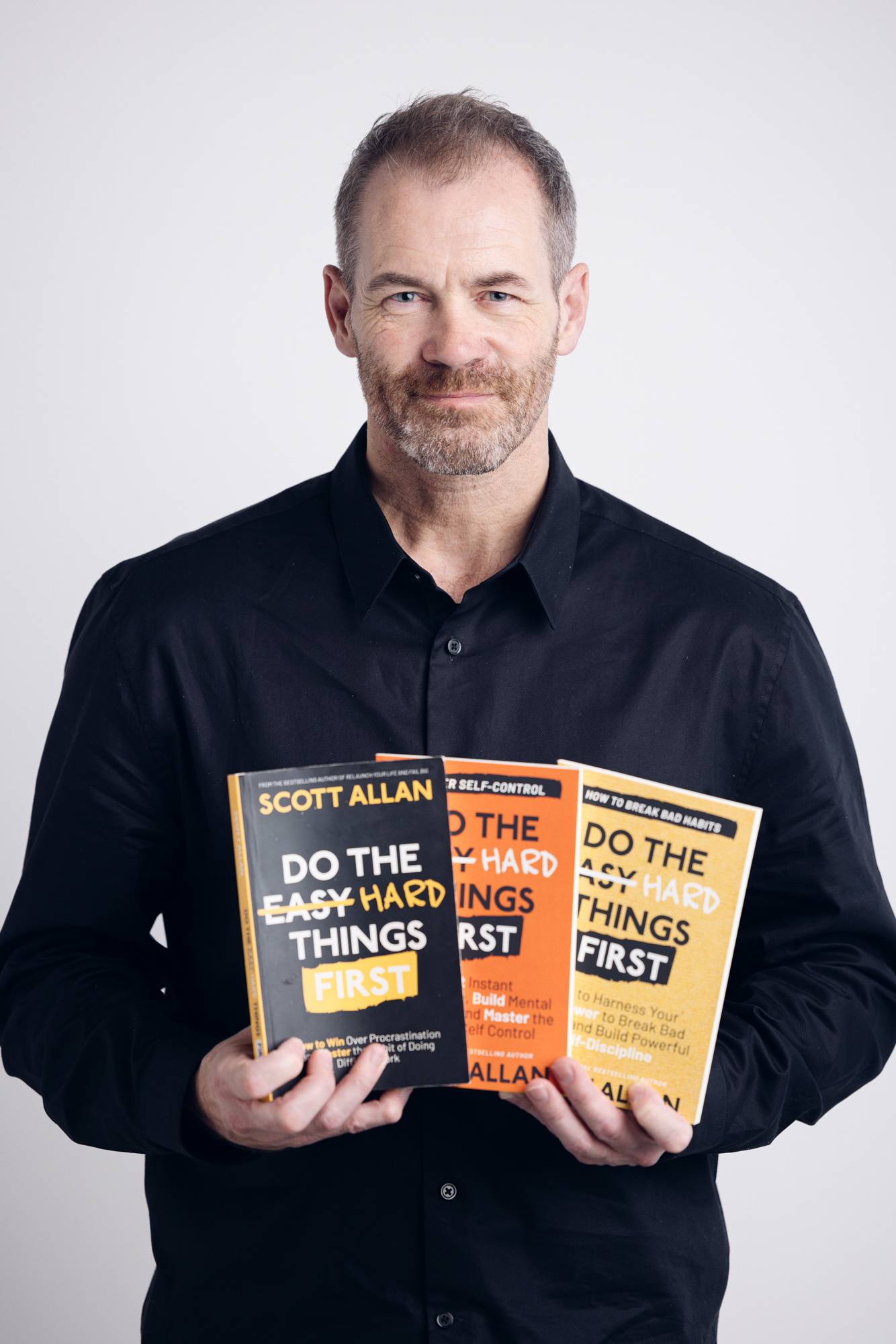
Do the Hard Things First is the complete system for doing exactly that.
JOIN THE CHALLENGE—YOUR NEW RESET BEGINS TODAY
→ Start the Challenge — Use promo code PROC10 for 10% off
→ Order Do the Hard Things First on Amazon
→ Or order directly from scottallanbooks.com
Want the full library? Scott Allan's Signature 16-Book Best Collection — sixteen books covering every hard thing across discipline, relationships, money, identity, and more.
 |
$5.00
Scott Allan
Hi, I'm Scott Allan...
Thank You for Your Support!
Your encouragement and support mean the world to me. If you’ve found... Read more |
